
You press the head of your whipped cream canister, and nothing comes out. Not a sound, not a drop of cream. The canister seems full, the product is not expired, and you bought it last week. This blockage almost always has a mechanical or thermal explanation, rarely a manufacturing defect.
The role of the propellant gas in a blocked whipped cream canister
Before shaking the canister in every direction, it’s essential to understand what happens inside. The cream doesn’t come out by magic: it’s a propellant gas (often nitrous oxide) that pushes the mixture towards the outlet valve and transforms it into airy foam in the process.
When this gas has escaped, even partially, the internal pressure drops. The cream remains at the bottom with no way to be expelled. This phenomenon occurs if the canister has been stored upside down, if the cap has been removed for too long, or if the valve has been subjected to a shock.
Have you noticed that a new canister emits a small hissing sound on the first press? This sound confirms the presence of pressurized gas. If you hear nothing, the propellant gas has probably escaped and the canister will no longer function normally. To find a solution if your whipped cream canister is blocked, you must first identify whether the problem comes from the gas or the valve.

Refrigerator temperature and cream consistency: two underestimated causes
The temperature plays a direct role in the functioning of a whipped cream canister. Cream that is too cold thickens to the point of not passing through the nozzle. Cream that is not cold enough, on the other hand, remains too liquid and comes out without forming foam, giving the impression that the canister is malfunctioning.
The right temperature range to unblock the cream
Take the canister out of the refrigerator five minutes before use. If it was stored at the back of the fridge, against the wall, the cream may have partially frozen. Run the canister under a stream of warm water (not hot) for about ten seconds, holding it upside down. The warm water softens the cream stuck in the pipe without compromising the gas.
If the canister has been at room temperature for several hours, place it back in the refrigerator for at least thirty minutes. The cream should be cold but not frozen to whip properly.
When the cream composition is problematic
Organic or additive-free whipped cream canisters have a different formulation from classic versions. The absence of stabilizers (carrageenan, guar gum) makes the cream more sensitive to temperature variations. It separates more easily into liquid and fatty phases, which clogs the ejection pipe.
Shake the canister vigorously, upside down, about fifteen times. This action helps to re-emulsify the mixture. If after this manipulation nothing comes out, the blockage is at the level of the valve or the nozzle.
Unblocking the valve and nozzle of a whipped cream canister
The valve is the most fragile part of the system. Dried cream residues accumulate around the nozzle after each use. Within a few days, these deposits harden and obstruct the passage.
Here are the steps to follow in order:
- Remove the nozzle (the small plastic piece through which the cream comes out) and soak it in hot water for a few minutes to dissolve the dry residues.
- With a toothpick or a fine needle, gently clear the valve opening on the canister, without pushing debris inside.
- Dry the nozzle, put it back in place, shake the canister upside down, then test by briefly pressing the head.
- If the cream comes out in spurts or with a sputtering sound, the valve is partially clogged but recoverable. Repeat the cleaning.
A nozzle cleaned with hot water after each use prevents the vast majority of blockages. It’s the simplest and most overlooked action.
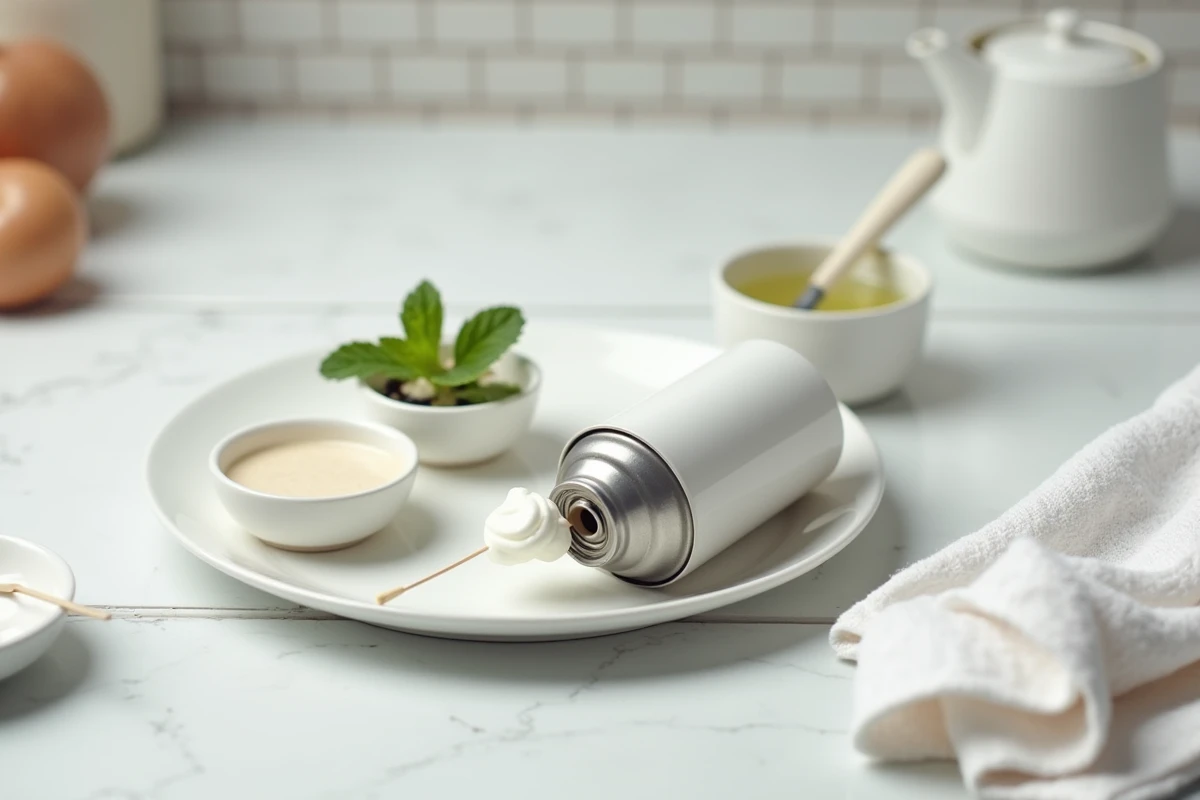
Kitchen siphon or disposable canister: the blockage is not treated the same way
Why distinguish between the two? Because the causes of blockage and the solutions differ depending on the type of container.
A rechargeable kitchen siphon works with individual gas cartridges. The blockage often comes from a poorly pierced cartridge or a worn seal. Check that the cartridge is properly screwed in and that the O-ring (the small rubber ring inside the lid) is not flattened or cracked. A damaged O-ring allows gas to leak within hours.
On a disposable commercial canister, you do not have access to these parts. The options are limited:
- Cleaning the nozzle and running it under warm water, as described above.
- Prolonged shaking upside down to force the re-emulsification of the cream.
- If no pressure is felt when pressing the head, the gas is depleted and the canister is no longer recoverable.
For a rechargeable siphon, replacing the seal or cartridge usually restarts the system. This is a clear advantage over disposable canisters, where gas loss signifies the end of the product’s life.
Preventing the blockage of a whipped cream canister before it occurs
Three habits significantly reduce the risk of malfunction:
Always store the canister upright, head up, in the door of the refrigerator. This position keeps the valve clear and the cream at the bottom, ready to rise under the effect of the gas.
Rinse the nozzle under hot water after each use, even if it’s quick. Cream residues dry within hours and form a solid plug.
Check the expiration date. Cream that has been prepared for a long time separates more easily. Fats rise, proteins coagulate, and the mixture becomes too thick to pass through the nozzle. This phenomenon accelerates if the refrigerator is set below 2 °C.
A whipped cream canister that refuses to work is not necessarily destined for the trash. In most cases, running it under warm water, cleaning the nozzle, or a good shake is enough to restart the mechanism. The only situation without recourse is the complete absence of gas, recognizable by total silence when you press the head.