
A poorly stored lithium-ion battery can undergo thermal runaway, meaning an uncontrolled rise in its internal temperature that can lead to a fire or explosion. The question of whether to separate batteries during storage depends on several factors: their chemistry, their state of health, and the storage density.
Experience from warehouse fires shows that the risk concentrates on clusters of batteries stored together, even if they are individually compliant. Understanding why physical separation changes the game allows for adopting the right reflexes, whether managing three rechargeable batteries or a fleet of industrial batteries.
Contact between batteries and short-circuit: the mechanism to understand
When two batteries touch, their positive and negative terminals can come into direct contact or via an interposed metallic object (key, screw, tool). This contact creates an external short-circuit that generates an intense current and a rapid rise in temperature.
On a lithium-ion battery, this overheating can trigger thermal runaway. The internal chemical reaction then becomes self-sustaining: the temperature rises exponentially, flammable gases are released, and the cell can ignite. If a neighboring battery is just a few centimeters away, the heat is enough to cause the same cascading phenomenon, known as thermal propagation.
This risk is not theoretical. Some insurers now recommend limiting storage density (number of batteries per square meter or per cabinet) and providing separate compartments rather than grouping everything into a single mass. A detailed article discusses battery storage on Read it with concrete recommendations on the spacing to be respected.

Separating healthy batteries from suspect batteries: the quarantine logic
Since 2023-2024, a practice is developing in professional facilities: systematically isolating damaged or suspect batteries from the rest of the stock. The principle relies on dedicated quarantine containers or cabinets, often fireproof.
A battery is considered suspect as soon as it shows swelling, deformation of the casing, signs of electrolyte leakage, or an unusual smell. Mixing such a battery with healthy units is akin to placing a potential detonator in the middle of the stock.
Criteria for triggering a quarantine
- Visible deformation of the casing or swelling of the cell, even slight
- Battery that has suffered a shock, fall, or crushing
- Abnormal overheating during the last use or charge
- Battery that has remained deeply discharged for a long period without monitoring
This separation is not only relevant for industrial warehouses. At home, an electric bike or drill battery that shows signs of fatigue should be isolated from others, ideally in a metallic container placed on a non-combustible surface.
Mixing battery chemistries: a common trap during storage
Lead-acid, lithium-ion, nickel-cadmium, and nickel-metal hydride batteries do not store the same way. Their optimal storage charge level differs, as do their temperature thresholds and recycling pathways.
End-of-life management guides emphasize the upstream separation of different types of batteries during temporary storage before collection. This source sorting is presented as essential to comply with regulatory obligations regarding hazardous waste. Mixing a leaking lead battery with lithium-ion cells in the same bin creates an additional chemical risk.
Specific case of boating and recreational vehicles
On a boat, specialists recommend physically separating starting and service batteries, not only for reasons of electrical autonomy but also for off-season storage. Starting batteries (often lead) and service batteries (increasingly lithium) have different maintenance charge needs and ideal temperature ranges.
The same reasoning applies in a motorhome or workshop: grouping batteries of different technologies in the same confined space multiplies the scenarios for cross-failure.
Optimal storage conditions to preserve battery lifespan
Beyond physical separation, the temperature and charge level at the time of storage determine a battery’s longevity.
- Storing lithium-ion batteries at a mid-level charge, around half of their capacity, reduces electrochemical stress on the cells
- Maintaining a stable ambient temperature, protected from direct heat and frost, limits degradation of internal components
- Avoiding humidity, which promotes corrosion of contacts and can cause micro-short-circuits between terminals
- Checking the charge level every few months for batteries stored for long periods to avoid irreversible deep discharge
Older nickel-cadmium batteries suffered from a rapid self-discharge phenomenon that required frequent recharges. Modern lithium-ion batteries lose their charge much more slowly, but prolonged complete discharge can permanently damage the cells.
Protecting terminals during storage
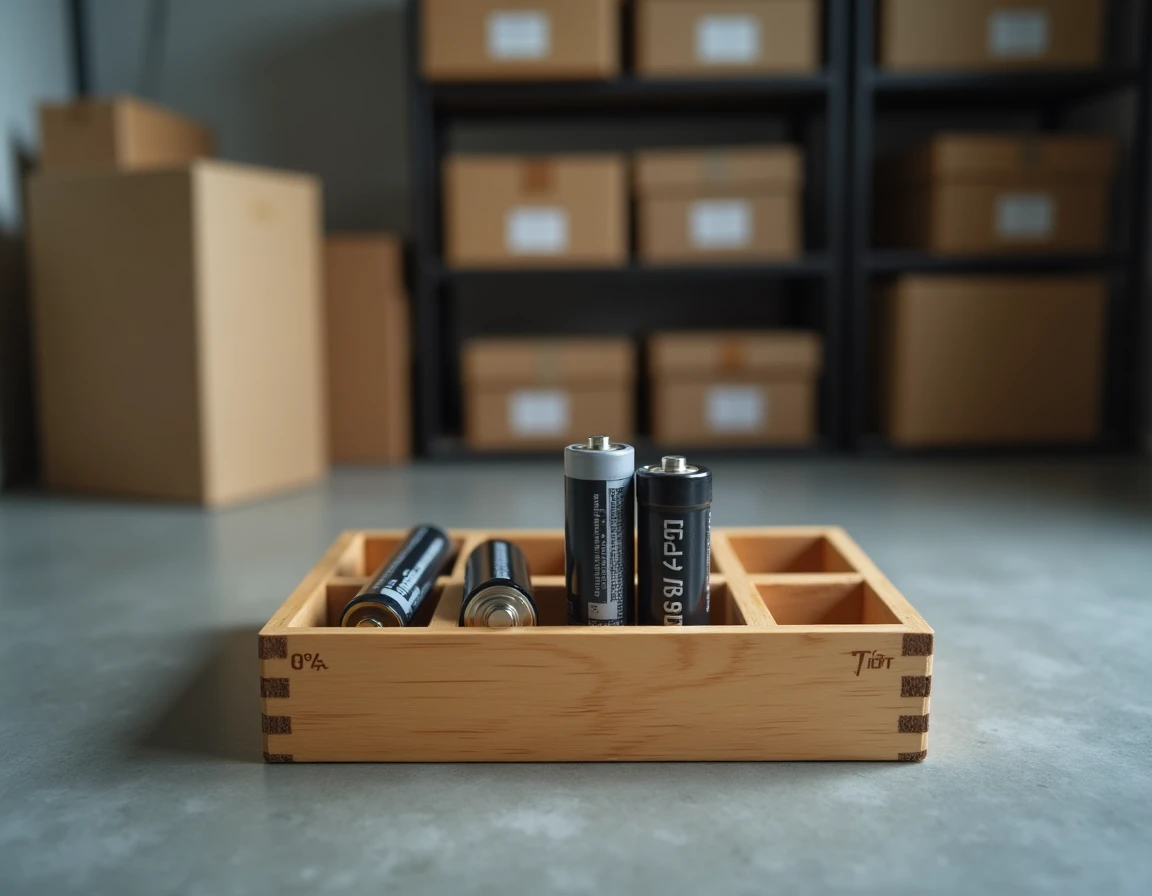
A simple gesture significantly reduces the risk of short-circuit: covering the terminals of each battery with insulating tape or using dedicated protective caps. This precaution applies equally to car batteries and small rechargeable AA batteries stored in a drawer.
Separating batteries during storage is not an excessive precaution but a technical measure consistent with the electrochemical functioning of these components. The degree of necessary separation varies according to the context: terminal caps and individual cases for home use, fireproof cabinets and quarantine zones for a professional fleet. The chemistry of each battery dictates its own temperature, charge, and compatibility constraints with its neighbors.