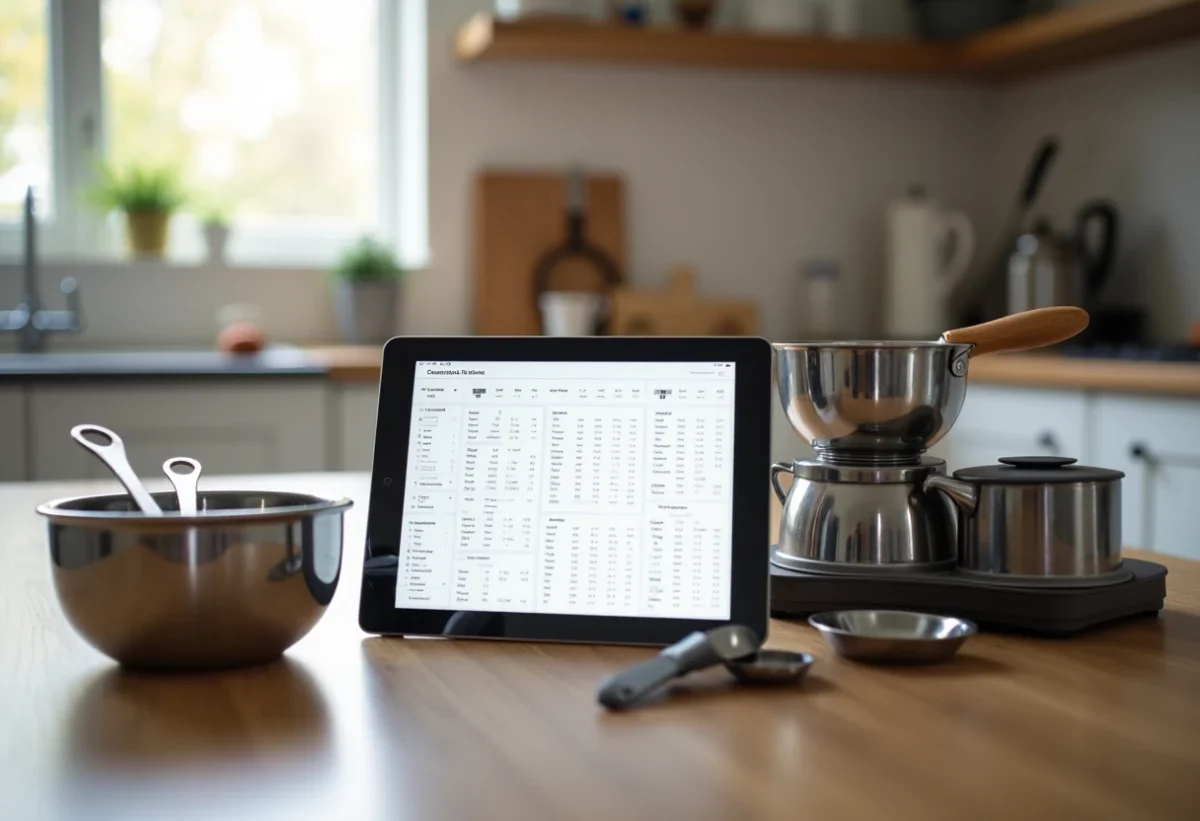
Preparing a meal can sometimes feel like a real puzzle when recipes use different measurements than what you’re used to. Between grams, ounces, cups, and milliliters, it’s easy to feel lost. Fortunately, a few tips can simplify these conversions and save time in the kitchen.
For example, did you know that one cup is approximately 240 milliliters, or that one ounce is about 28 grams? Keeping these equivalents handy can transform your cooking experience, making international recipes much more accessible and enjoyable to follow.
Understanding Measurement Units in Cooking
To excel in the art of cooking, understanding measurement units is essential. Cooking and mixology require a mastery of measurements to ensure accurate and flavorful results. Measurements are primarily divided into three categories: volume, weight, and temperature.
Volume Units
Volume units include common measurements such as liter (l), milliliter (ml), and centiliter (cl). A conversion that is often necessary is that of milliliters to centiliters: 400 ml to centiliters equals 40 cl. For smaller quantities, the tablespoon (tbsp) and teaspoon (tsp) are frequently used, with 1 tbsp equaling 15 ml and 1 tsp equaling 5 ml.
Weight Units
Weight units include kilogram (kg) and gram (g). An ounce (oz) is also used, primarily in Anglo-Saxon recipes, and equals 28.35 g. To convert weight measurements accurately, it is helpful to remember that 1 kg equals 1000 g.
Temperature Units
In cooking, temperatures are expressed in degrees Celsius (°C) or degrees Fahrenheit (°F). Converting these temperatures is fundamental for successfully executing recipes from different regions of the world. For example, 0° Celsius equals 32° Fahrenheit, and 100° Celsius equals 212° Fahrenheit.
| Unit | Equivalence |
|---|---|
| 1 cl | 10 ml |
| 1 dl | 100 ml |
| 1 kg | 1000 g |
| 1 ounce (oz) | 28.35 g |
Understanding these conversions and their equivalents greatly facilitates culinary preparation, allowing for precise adherence to recipes and achieving the desired results. 
Simple Techniques for Accurately Converting Measurements
To avoid conversion errors, use appropriate conversion tools. Mobile apps, cookbooks, and practical guides offer precise and accessible solutions.
Measuring Tools
Measuring tools are essential for ensuring accuracy. Here are some must-haves:
- Measuring cup: ideal for liquids, with graduations in milliliters and centiliters.
- Kitchen scale: allows for accurate weighing of dry ingredients like flour and sugar.
- Cooking thermometer: indispensable for monitoring cooking temperatures.
- Measuring spoons: useful for small quantities, with measurements in milliliters and grams.
Manual Conversion and Digital Tools
For those who prefer manual conversion, conversion charts remain reliable references. They provide simple equivalents to use, for example: 1 cup of flour equals 130 g, 1 cup of sugar equals 245 g. Online calculators and mobile apps simplify complex conversions, especially when working with Anglo-Saxon measurements.
Using these techniques allows for precise adherence to recipes and consistent results. Mastering conversions is a major asset for any cook, amateur or professional, ensuring accuracy and quality in every preparation.