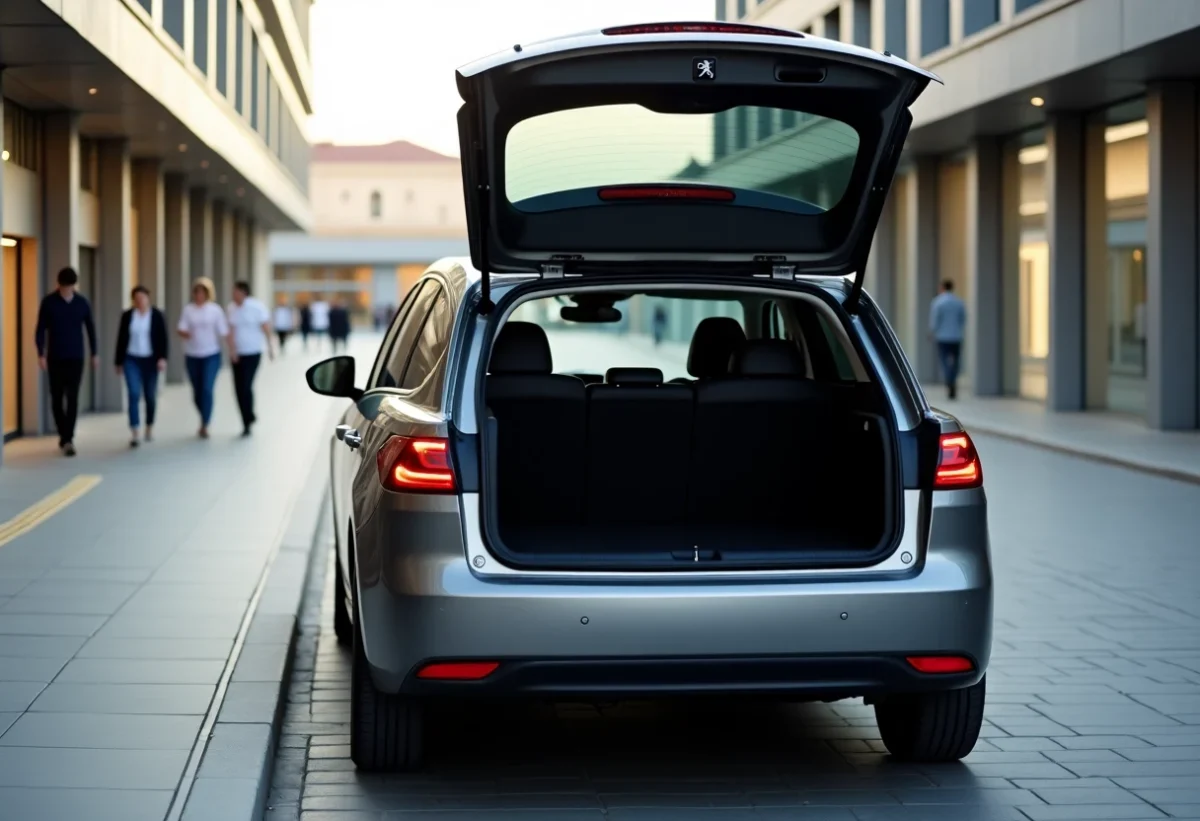
When it comes to choosing a compact car, trunk capacity is often a determining factor. The Peugeot 308, with its sleek design and remarkable performance, attracts many eyes. But how does it stack up against its competitors in terms of trunk volume?
The Peugeot 308 offers a generous cargo space of 420 liters, surpassing models like the Volkswagen Golf and the Ford Focus. This makes it an ideal option for families and urban adventurers. Comparing these volumes allows for an informed choice based on daily needs and occasional getaways.
Comparison of Trunk Volumes of Major Compact Cars
To better understand where the Peugeot 308 stands in the landscape of compact cars, let’s examine the trunk volumes of several popular models. This comparison helps to better understand the strengths and weaknesses of each vehicle.
- Honda Civic: 440 dm3
- Fiat Tipo Cross: 439 dm3
- Skoda Scala: 432 dm3
- Hyundai i30 Fastback: 427 dm3
- Kia Ceed: 404 dm3
- Toyota Prius: 400 dm3
- Peugeot 308: 397 dm3
- Audi A3: 393 dm3
- Hyundai Ioniq Hybrid: 387 dm3
- Citroën C4: 380 dm3
- DS 4: 371 dm3
- Toyota Corolla: 365 dm3
- Citroën C4 X: 610 dm3
- Kia ProCeed: 540 dm3
- Audi A3 Sedan: 510 dm3
- Mercedes CLA: 509 dm3
- BMW 2 Series Gran Coupe: 464 dm3
- Peugeot 308 SW: 608 liters, optimized to 1,634 liters with the rear seats folded down
The trunk 308 volume of 397 dm3, although slightly lower than some competitors, remains quite competitive. In contrast, the Peugeot 308 SW stands out with an impressive volume of 608 liters, or even 1,634 liters once the rear seats are folded down. This more spacious version meets more demanding loading needs.
The analysis of this data shows that each model has its own strengths. The Citroën C4 X, for example, offers a particularly generous trunk volume of 610 dm3, while the Kia ProCeed provides 540 dm3. For those seeking a compromise between compactness and loading capacity, the Peugeot 308 is a balanced option. 
Detailed Analysis of the Peugeot 308 Trunk Volume
The Peugeot 308, a key model in the compact segment, has seen its trunk volume decrease by 8 dm3 compared to the previous generation, now reaching 397 dm3. This decrease is partly explained by design and architecture choices. The new model features a longer and lower hood, a windshield pushed back by 10 cm, and wheels at all four corners, increasing the length of the car by 11 cm and stretching the wheelbase by 5.5 cm.
With a muscular and compact design, the Peugeot 308 stands out for its perceived quality superior to its competitors. The sporty and streamlined interior offers improved rear seat space, despite the reduced trunk volume. This configuration aims to optimize passenger comfort without excessively sacrificing loading capabilities.
| Features | Details |
|---|---|
| Trunk Volume | 397 dm3 |
| Length | Increased by 11 cm |
| Wheelbase | Extended by 5.5 cm |
| Design | Muscular and compact |
| Habitability | Improved in the rear seats |
Offering two Puretech petrol engines of 110 and 130 hp, a BlueHDI diesel version of 130 hp, as well as two plug-in hybrid engines of 180 hp and 225 hp, the Peugeot 308 adapts to various consumption and performance requirements. A sporty electrified version, the PSE, is also in preparation, promising to add an extra dimension to this already versatile model.
Despite a slight decrease in its trunk volume, the Peugeot 308 continues to position itself as a benchmark in the compact segment thanks to its design, habitability, and multiple engine options.