
A mortgage can finance much more than the purchase of a home. When a renovation project exceeds a certain amount, integrating the work into a mortgage allows for a lower rate than a traditional consumer loan, with monthly payments spread over a long period. However, this mechanism remains poorly understood, especially since recent regulatory changes have redefined the boundary between consumer credit and mortgage credit for renovation loans.
Threshold of 100,000 euros and the ordinance of September 2025: what changes for renovation loans
The distinction between consumer credit and mortgage credit is partly based on the amount borrowed and the presence or absence of a mortgage guarantee. Ordinance No. 2025-880 of September 3, 2025, supplemented by the decree of August 7, 2026, has clarified this framework.
For work not secured by real estate collateral, a loan of 100,000 euros or less remains subject to the consumer credit regime. This regime implies a different usury rate, shorter repayment periods, and specific borrower protections.
Beyond this threshold, or as soon as a mortgage is established, the loan shifts to the mortgage credit regime. Borrowers considering extensive renovations should therefore calibrate their project in advance: the choice of the legal regime of the loan directly depends on the amount and type of guarantee chosen.
To obtain more information on credit-et-immobilier.com, comparing offers between renovation loans and traditional mortgage loans helps identify the best formula for each situation.
Progressive release of funds: how the bank controls the financing of the work
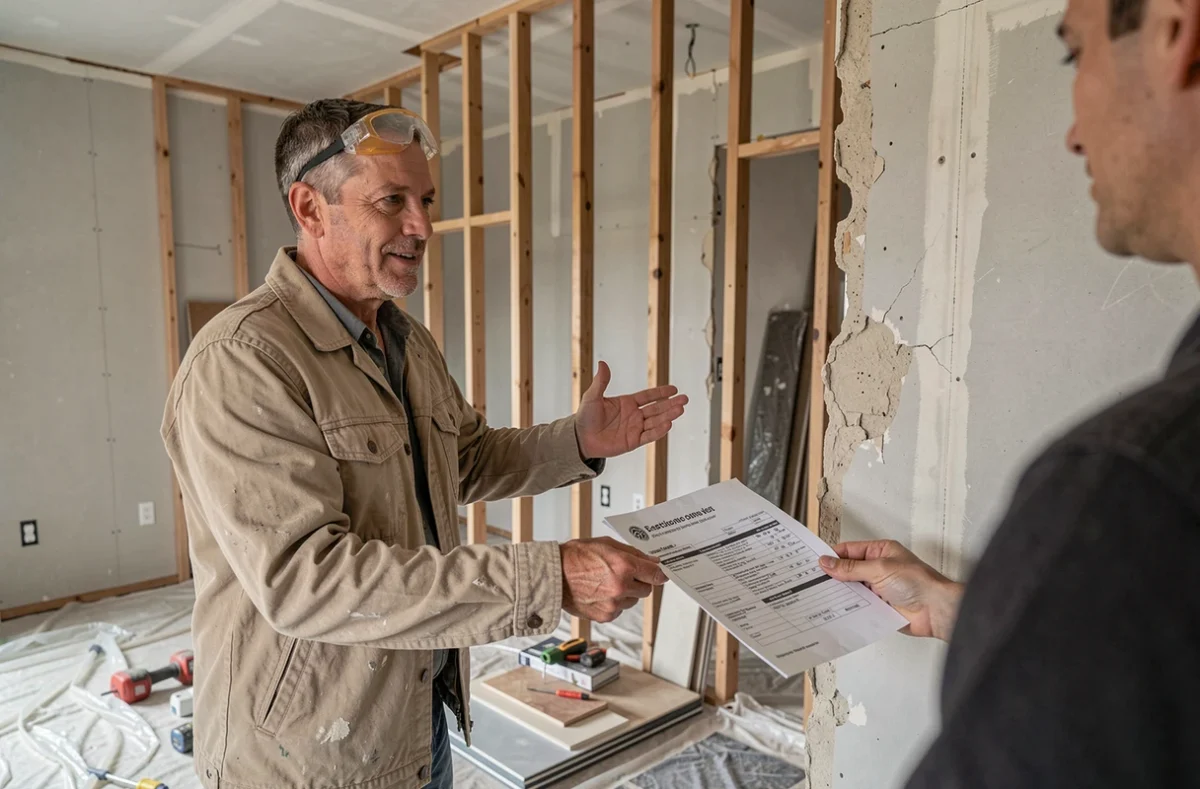
Unlike a personal loan disbursed in one lump sum to the borrower’s account, the mortgage for renovations operates through progressive disbursement. The bank releases funds as the project progresses, upon presentation of invoices issued by professional craftsmen.
This operation has a direct consequence on the project’s timeline. During the renovation phase, the borrower pays interim interest calculated only on the amount already released. Full monthly payments (principal + interest) only begin once the entire loan is mobilized.
The bank generally requires detailed quotes before granting financing. Self-performed work is rarely accepted in this context: the lending institution wants invoices from craftsmen to justify each disbursement. This point effectively excludes partially self-built projects, unless specific agreement is reached.
MaPrimeRénov’ and extensive renovation: coordinating aid with mortgage credit
The amount actually financed by the credit also depends on public aid obtained in parallel. The MaPrimeRénov’ scheme, in its extensive renovation pathway, imposes several conditions that directly influence the banking financing plan:
- A prior energy audit is mandatory to assess the performance gains of the home before the start of the work.
- The intervention of a Mon Accompagnateur Rénov’ is required to validate the project and coordinate the various steps of the file.
- The project must allow for a gain of at least two classes on the energy performance diagnosis (DPE) of the home.
- Since September 2026, individual houses retaining gas or oil heating are excluded from this pathway, which may impose additional equipment replacement work.
The coordination between the timeline for submitting the MaPrimeRénov’ file and the mortgage credit application deserves particular attention. Submitting an aid application too late can change the amount that actually needs to be financed by the loan. Since the aid is only paid after the work is validated, the bank must incorporate this delay into the cash flow plan.
Eco-PTZ and renovation advance loan: two zero-interest supplements

Two zero-interest schemes can complement a mortgage to reduce the overall cost of financing.
The zero-interest eco-loan (eco-PTZ) finances energy renovation work without interest for the borrower. It can be combined with a traditional mortgage and with MaPrimeRénov’. Its amount varies depending on the nature and number of works undertaken.
The zero-interest renovation advance loan (PAR+) is aimed at owner-occupiers with modest resources. Its operation differs radically from a traditional loan: the repayment of the principal is made in one lump sum, upon the sale of the property or at the time of succession. This mortgage loan allows for work to be initiated without increasing the household’s monthly expenses. It is interest-free for the first ten years of the loan and limited to one loan per property.
For co-owners, collective financing of energy renovation work represents an underutilized lever. The MaPrimeRénov’ co-ownership aids allow for the costs of work on common areas to be pooled, reducing the share to be financed individually by each co-owner.
Debt ratio and loan duration: the constraints of the banking file
Integrating work into a mortgage mechanically extends the loan duration or increases monthly payments. The rules of the High Council for Financial Stability (HCSF) govern these parameters: the debt ratio must not exceed a fixed ceiling, and the maximum repayment duration remains constrained.
Smoothing the monthly payments allows for combining a main mortgage with an eco-PTZ or a complementary renovation loan, while maintaining a constant repayment burden. The bank adjusts the due dates of the various loans so that the total monthly payment remains below the authorized debt threshold.
- Plan for quotes and the energy audit before applying for the loan to present a complete file to the bank.
- Check eligibility for public aid in advance, as their amount directly modifies the capital to be borrowed.
- Anticipate the gap between the payment of aid (after work) and the disbursement of credit (during work).
The financial setup of an extensive renovation often combines three or four sources: mortgage, eco-PTZ, MaPrimeRénov’, sometimes a PAR+. Each aid has its own timeline, its own conditions, and its own validation circuit, making the coordination of the file as crucial as the choice of the rate.